
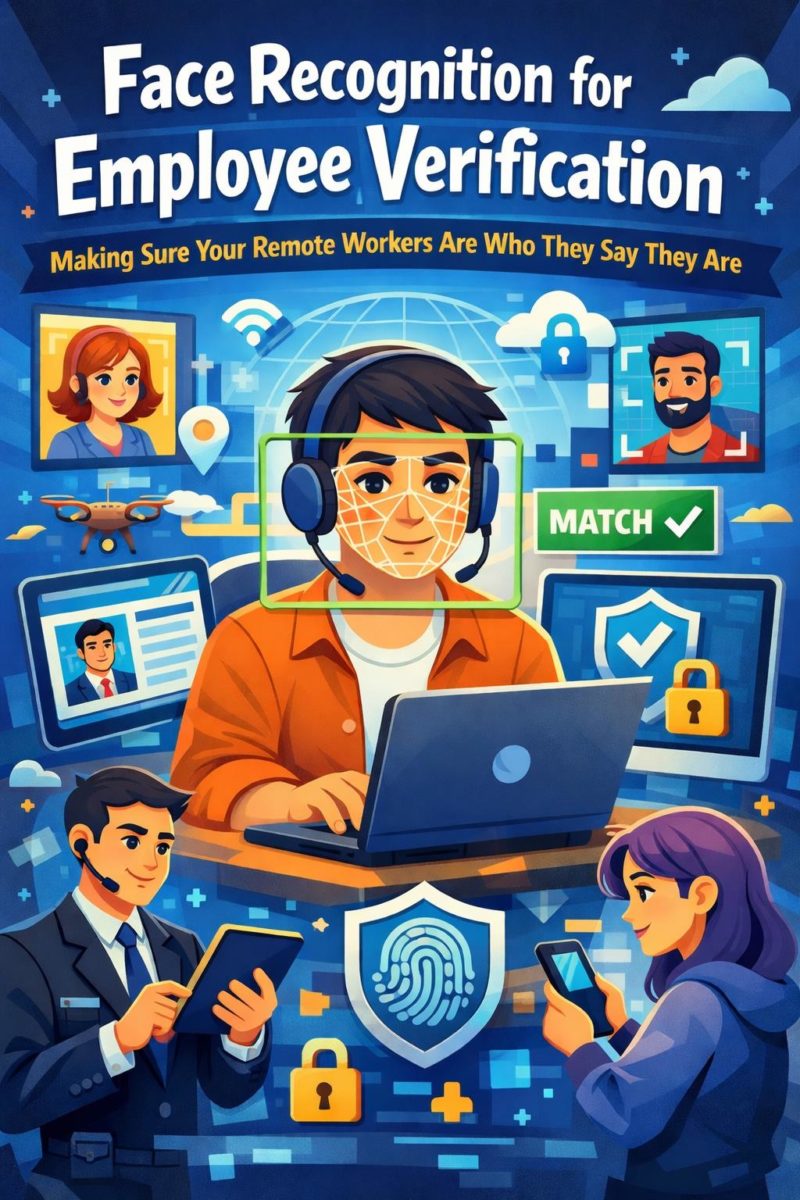
The remote work revolution brought a lot of good things. Access to global talent. Lower overhead costs. Flexibility that employees actually want. But it also created a problem that keeps managers up at night: how do you know the person doing the work is the person you hired?
This isn’t paranoia. It’s a real concern that costs businesses millions every year through time theft, identity fraud, and schemes where someone else performs the job entirely.
The Cost of Not Knowing Who’s Working
Time theft hits businesses harder than most realize. The American Payroll Association found that employers lose around 4.5 hours per week per employee to various forms of time theft. For someone earning $15 an hour, that’s roughly $3,500 gone every year. Multiply that across a company of 50 people and you’re potentially losing over $175,000 annually.
Then there’s buddy punching. About 75% of U.S. businesses deal with it. That’s when one employee clocks in or out for another. Nearly one in five employees admit they’ve done it for a coworker. Seems harmless enough, right? Except it accounts for about 2.2% of gross payroll losses across affected companies.
But these are the old problems. Remote work introduced new ones that are far worse.
The Proxy Worker Problem
Here’s a scenario that’s becoming disturbingly common: a skilled interviewer lands the job, but someone completely different shows up to do the actual work.
In documented cases, companies realized the person who aced their technical interviews wasn’t the same person accessing their systems every day. The interview candidate was essentially a hired gun – someone who interviews well and then hands off the position to whoever is actually going to do the work.
Sometimes it’s not even that organized. An employee accepts a full-time remote position, then quietly subcontracts the work to someone overseas while collecting the full salary. The employer has no clue who’s actually handling their sensitive data and accessing their systems.
The U.S. Department of Justice investigated operations where thousands of IT workers used stolen identities to infiltrate hundreds of American companies. These weren’t isolated incidents. It was systematic fraud at scale.
The Overemployment Scheme
Some people have figured out they can hold multiple full-time remote jobs at once. They use avatar software during meetings, keep their cameras off whenever possible, and juggle responsibilities across different employers.
On paper, they’re a dedicated full-time employee. In reality, you’re getting maybe 10-15 hours of actual attention per week while paying for 40. Quality suffers. Deadlines slip. And you have no idea why because your “full-time” employee seems to be online and responsive.
There are entire communities online dedicated to teaching people how to pull this off. They share tips on managing overlapping meetings, which jobs are easiest to juggle, and how to avoid detection.
Deepfake Interviews
This one sounds like science fiction, but it’s happening now. People use AI tools to alter their face and voice in real-time during video calls. An unqualified candidate can present themselves as someone completely different – sometimes even impersonating a real person whose credentials they’ve stolen.
The technology is good enough that hiring managers don’t notice anything wrong. The candidate passes multiple interview rounds, gets hired, and then either can’t do the job or was never planning to do it themselves in the first place.
The “Clock In and Disappear” Problem
Even without elaborate fraud schemes, remote work makes simple time theft trivially easy. Someone clocks in at 9am, does an hour of work, runs errands until 4pm, puts in another hour, and clocks out at 5. Their timesheet shows 8 hours. They worked 2.
With no one watching, there’s no accountability. Traditional time tracking systems only know when someone clicked a button. They have no idea if anyone was actually there.
Why Traditional Verification Doesn’t Work Anymore
In an office, these problems mostly solve themselves. You can see who’s at their desk. You recognize faces. You notice when someone’s not around.
Remote work removed all of that. The verification methods that replaced it are weak:
Passwords and logins can be shared with anyone. If your employee gives their credentials to a friend or contractor, you’d never know.
Periodic check-ins are easy to game. Show up for the standup meeting, disappear for the rest of the day.
Activity monitoring tells you a keyboard is being used, not who’s using it.
Video calls can be faked, avoided, or attended by the “real” employee while someone else does the actual work.
None of these methods answer the basic question: is the person I hired the person doing the work right now?
What Actually Solves This
Face recognition tied to time tracking closes these gaps. The concept is straightforward: verify that the person at the computer is the person you hired, not just at clock-in, but continuously throughout the workday.
This makes proxy workers impossible. It doesn’t matter if someone else has the login credentials – if their face doesn’t match the profile, the system knows.
Overemployment schemes fall apart when you can’t just “be online” without actually being present at your computer.
The clock-in-and-disappear problem goes away when verification happens every few minutes, not just at the start and end of the day.
And buddy punching becomes a thing of the past. You can’t clock in for someone else when the only way to clock in is with your own face.
The Privacy Concern
The obvious objection is privacy. Facial recognition at work sounds invasive. And it can be, if implemented poorly.
The key differences that make it acceptable:
Local processing. Good systems do all the face verification on the employee’s own device. The biometric data never leaves their computer. There’s no central server collecting face images.
No photo storage. The system converts faces into encrypted mathematical representations. It’s not storing pictures of employees. It can’t be turned back into photos.
Verification only. The system answers one question: is this the right person? It’s not tracking expressions, emotions, or anything else. It’s not surveillance. It’s identity confirmation.
Employee control. People can see what data exists about them and delete it if they leave the company.
When done right, it’s less invasive than having a manager look over your shoulder in an office – which was considered completely normal for decades.
The Bottom Line
Remote work created a verification vacuum. Traditional methods don’t work when you never see someone in person. The result is a growing industry of fraud – from simple time theft to elaborate identity schemes.
Face recognition in time tracking fills that gap. It answers the question that every remote employer needs answered: is the person I’m paying actually the person doing the work?
The companies that figure this out will be able to hire remotely with confidence. The ones that don’t will keep paying for work that isn’t being done by the people they think they hired.
SCREENish offers time tracking with continuous face verification, built for remote teams who need to know their workers are who they say they are.


